The Social Life of Economic Inequalities in Contemporary Latin America by Margit Ystanes & Iselin Åsedotter Strønen
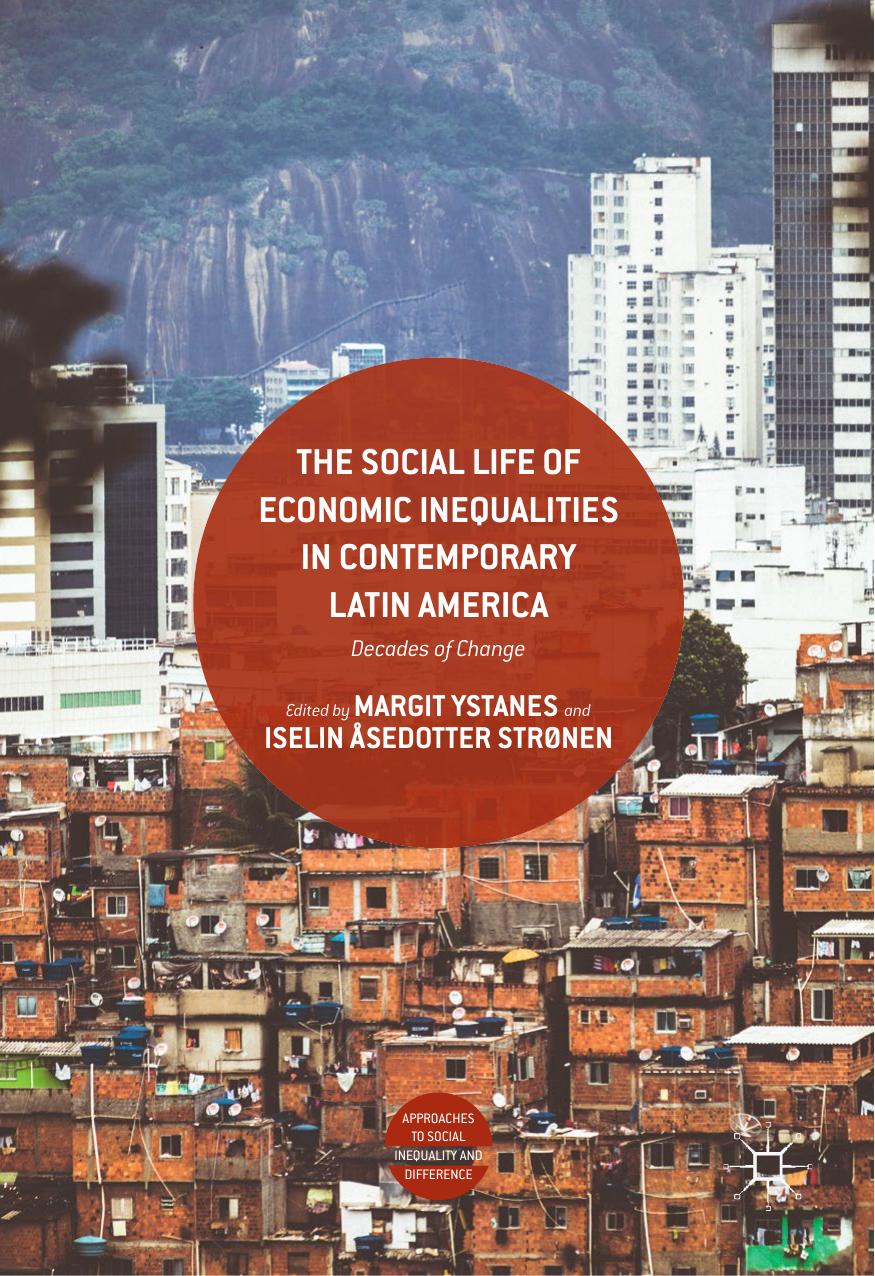
Author:Margit Ystanes & Iselin Åsedotter Strønen
Language: eng
Format: epub, pdf
Publisher: Springer International Publishing, Cham
“Being Poor”: Meanings and Perceptions in the Favela
The implementation of public policies in the favelas is not something new in the history of Rio de Janeiro (see, e.g. Magalhães 2013). Valladares (2000, 2005) explains how favelas were introduced and treated in the political and social debate in the city. The author also discusses how knowledge about the favelas has been perceived and constructed throughout the twentieth century, and how a negative image of these communities, associating the place and its people with poverty, dirt and trickery, has been forged. Silva stresses that favelas are often studied under two different approaches: “one that intends to formulate ‘solutions’ to the ‘social problems’ in the communities and another that seeks to generate political and ideological lines of action” (Silva 2011, 699). However, favela dwellers are not a homogeneous population (see, e.g. Larkins 2015; Pearlman 2010). Nevertheless, the association between the favela and poverty in Brazil is constructed automatically by most of the Brazilian population, including those who are agents in social assistance programmes.
Residents of the Pavão-Pavãozinho favelas interviewed for this study did not always hold the perception that being a resident of the favela was synonymous with being poor, nor that it denoted eligibility for the BFP. This shows a plurality of perceptions and criteria related to the term poverty across and within social groups. Some of these differences can be discerned in the meanings that favela residents attribute to poverty and to being poor.
In the favela, accounts of being poor and of poverty are related to income , but they go beyond it as well. According to one resident, not having a decent bathroom in your house is a sign of extreme poverty. When being invited into private homes in the favela, you often find that the bathrooms only have a toilet and no shower, or that the toilet is broken. Often there is a lack of water. Other homes have bathrooms constructed as outhouses, and many have water containers on the outside of the house. In one of the houses I visited, the woman gave her children baths using a large water container outside the front door. Utilisation of water containers was also reported by Cunha: “these containers are used to store water, as a way for residents to work around the many days that they did not have water in their houses” (Cunha 2011, 16). In some areas, a turn-taking system of water collection known as a “maneuver” is used, consisting of a “local system in which residents redirect the course of water each day to a certain area of the favela, since the public system does not reach all houses” (Cunha 2011, 16, see also Cunha 2014).
By assessing levels of poverty in a concrete fashion by people’s relative access to basic services and needs, people in the favelas deploy categorisations of poverty that resembles that of Gutíerrez, who considers poverty as a descriptive category based on comparative indicators vis-à-vis other individuals (Gutíerrez 2007). In that regard, housing issues need to be emphasised as an emic indicator of poverty for residents.
Download
The Social Life of Economic Inequalities in Contemporary Latin America by Margit Ystanes & Iselin Åsedotter Strønen.pdf
This site does not store any files on its server. We only index and link to content provided by other sites. Please contact the content providers to delete copyright contents if any and email us, we'll remove relevant links or contents immediately.
International Integration of the Brazilian Economy by Elias C. Grivoyannis(111609)
The Radium Girls by Kate Moore(12185)
Turbulence by E. J. Noyes(8215)
Nudge - Improving Decisions about Health, Wealth, and Happiness by Thaler Sunstein(7862)
The Black Swan by Nassim Nicholas Taleb(7277)
Rich Dad Poor Dad by Robert T. Kiyosaki(6857)
Pioneering Portfolio Management by David F. Swensen(6405)
Man-made Catastrophes and Risk Information Concealment by Dmitry Chernov & Didier Sornette(6228)
Zero to One by Peter Thiel(5952)
Secrecy World by Jake Bernstein(4889)
Millionaire: The Philanderer, Gambler, and Duelist Who Invented Modern Finance by Janet Gleeson(4603)
The Age of Surveillance Capitalism by Shoshana Zuboff(4438)
Skin in the Game by Nassim Nicholas Taleb(4386)
The Money Culture by Michael Lewis(4340)
Bullshit Jobs by David Graeber(4339)
Skin in the Game: Hidden Asymmetries in Daily Life by Nassim Nicholas Taleb(4129)
The Dhandho Investor by Mohnish Pabrai(3887)
The Wisdom of Finance by Mihir Desai(3864)
Bull by the Horns: Fighting to Save Main Street From Wall Street and Wall Street From Itself by Sheila Bair(3741)
